From TurboMax to Duramax: How the 2026 Silverado 1500 Covers More Powertrain Ground Than the F-150
Two trucks, two very different answers to the same question: which full-size pickup actually delivers for British Columbia drivers? The 2026 Chevrolet Silverado 1500 and the 2026 Ford F-150 both cover the full-size pickup segment, but they reach for different strengths. If you tow heavy, work the bed hard, or want a diesel option, the […]
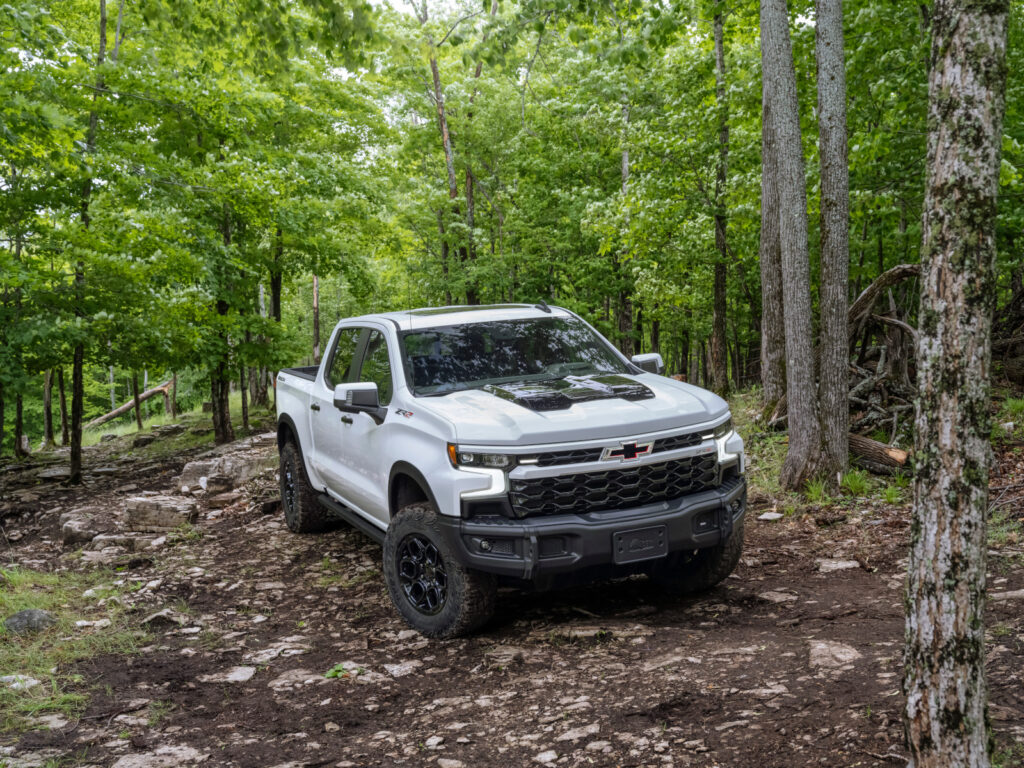
Two trucks, two very different answers to the same question: which full-size pickup actually delivers for British Columbia drivers?
The 2026 Chevrolet Silverado 1500 and the 2026 Ford F-150 both cover the full-size pickup segment, but they reach for different strengths. If you tow heavy, work the bed hard, or want a diesel option, the gaps between them matter. Here is what the numbers say.
2026 Silverado 1500 vs. F-150: Side-by-Side
| Spec | 2026 Silverado 1500 | 2026 F-150 |
| Short-bed cargo volume | 1,781 L | 1,494.8 L |
| Cargo box length (short bed) | 1,776 mm | 1,705 mm |
| Diesel option | Yes – Duramax 3.0L | No |
| Standard fuel tank | 91 L | 87 L |
| Engine lineup | TurboMax 2.7L I-4T, 5.3L V8, 6.2L V8, Duramax 3.0L diesel | 2.7L EcoBoost V6, 3.5L EcoBoost V6, 5.0L V8, PowerBoost Hybrid, H.O. 3.5L EcoBoost |
| TurboMax torque | 430 lb-ft | – |
| Max towing | 13,300 lbs | 13,500 lbs (3.5L EcoBoost, specific config) |
| Warranty basic / powertrain | 3 yr/60,000 km – 5 yr/100,000 km | 3 yr/60,000 km – 5 yr/100,000 km |
| Hands-free highway driving | Super Cruise (available) | BlueCruise (available) |
Powertrain: More Choices, More Torque at the Low End
The Silverado’s 2.7L TurboMax four-cylinder serves as the base engine across most trims: 310 hp and 430 lb-ft of torque. That torque arrives low in the rev range, making it feel strong when loaded. Step up to the 5.3L ECOTEC3 V8 for 355 hp and 383 lb-ft, or go further with the 6.2L V8 at 420 hp and 460 lb-ft.
The standout remains the available 3.0L Duramax turbo-diesel: 305 hp and 495 lb-ft, built for long-haul towing with lower running costs.
The F-150’s 2.7L EcoBoost V6 opens at 325 hp and 400 lb-ft, competitive, but 30 lb-ft behind the TurboMax. The F-150’s strongest conventional gas option, the 3.5L EcoBoost V6, reaches 400 hp and 500 lb-ft, and the PowerBoost Full Hybrid V6 delivers 420 hp and 570 lb-ft for highway fuel savings. The F-150 carries no diesel; the Silverado’s Duramax is the only diesel available in this comparison.
- Silverado TurboMax: 310 hp, 430 lb-ft, strong torque from a four-cylinder base
- Silverado 5.3L V8: 355 hp, 383 lb-ft, the workhorse V8 for most towing tasks
- Silverado 6.2L V8: 420 hp, 460 lb-ft, top gas option for heavy pulls
- Silverado Duramax 3.0L diesel: 305 hp, 495 lb-ft, no equivalent in the F-150 lineup
Towing and Payload: Where the Silverado Pulls Ahead
The Silverado 1500 reaches a maximum towing rating of 13,300 lbs. With the 5.3L ECOTEC3 V8, that peaks at 10,800 lbs; the TurboMax manages 9,200 lbs; the Duramax diesel reaches 8,700 lbs. The Duramax also carries the highest gross combined weight rating in the lineup at 17,800 lbs. The F-150’s 3.5L EcoBoost V6 edges just above the Silverado’s overall peak at 13,500 lbs, but that figure requires the XLT SuperCrew 4×4 with the Tow/Haul Package and Max Tow Axle, a specific, fully optioned build. The F-150’s base 2.7L EcoBoost tops out at 8,400 lbs.
On payload, the Silverado WT Regular Long Bed 2WD carries up to 2,443 lbs (1,108 kg), and the ZR2 Crew Short Bed 4WD reaches 2,474 lbs (1,122 kg). The F-150 SuperCrew, properly configured, reaches a maximum payload of 2,235 lbs (1,013.8 kg), a step behind the Silverado’s top-payload configurations.
The Silverado’s towing technology package is also deeper. Hitch Guidance is standard on 4WD Custom and above; up to 8 cameras with 14 views are available on higher trims; the In-Vehicle Trailering App includes a pre-departure checklist, trailer theft detection, and tire pressure monitoring. Trailer Sway Control via StabiliTrak is standard across the lineup, and the Duramax adds a Diesel Exhaust Brake through Tow/Haul mode, a real advantage on British Columbia mountain grades.
Cargo Box and Bed
The Silverado’s short bed (Crew Cab) measures 1,776 mm in length and delivers 1,781 L of volume. The F-150’s 5.5-foot box comes in at 1,705 mm and 1,494.8 L, the Silverado short bed holds about 286 L more. Both boxes share a similar width between wheelhouses (Silverado: 1,286 mm; F-150: 1,287 mm), but the Silverado is taller inside at 569 mm versus the F-150’s 543 mm.
The Silverado ZR2 includes the Multi-Flex tailgate with six configurations as standard equipment, and it is available on other Silverado trims. The F-150 offers its Pro Access Tailgate, which swings out 100 degrees or drops traditionally, getting you up to 19 inches closer to cargo, a different approach that suits its own use cases.
Interior and Technology
From the LT trim up, the Silverado comes standard with a 13.4-inch Chevrolet Infotainment 3 Premium system with Google Built-in, paired with a 12.3-inch Driver Information Centre. Super Cruise hands-free highway driving is available on the High Country. The LTZ adds a Bose premium audio system and front bucket seats as standard.
The F-150 pairs a 12-inch centre display with Ford Co-Pilot360, which covers Pre-Collision Assist, Adaptive Cruise Control with Stop-and-Go, and BLIS with Trailer Coverage. BlueCruise hands-free highway driving is available. The F-150 also offers a stowable gear shifter that folds flat into a work surface, practical for job-site use. While the F-150’s centre display is smaller, Ford’s Connectivity Package adds unlimited Wi-Fi for up to 10 devices; the Silverado’s Google Built-in integration gives a deeper native navigation and voice assistant experience.
Fuel Economy at a Glance
| Configuration | City | Hwy |
| Silverado WT 4WD (TurboMax) | 13.7 L/100 km | 11.8 L/100 km |
| Silverado ZR2 4WD | 11.6 L/100 km | 10.5 L/100 km |
| F-150 3.5L EcoBoost 4×2 | 13.4 L/100 km | 10.2 L/100 km |
| F-150 PowerBoost Hybrid 4×4 | 10.5 L/100 km | 10.4 L/100 km |
The Silverado’s standard 91 L tank gives it a range advantage over the F-150’s 87 L base tank. The F-150 PowerBoost hybrid leads on combined economy at its configuration’s rated figures, though the Silverado’s Duramax diesel offers a long-haul efficiency profile the F-150 cannot replicate, no diesel exists in the F-150 lineup.
Which Truck Fits Your Needs?
For towing, the Silverado’s engine breadth is the deciding factor. Four powertrain options, including the only diesel in this segment, mean you match the engine to the job rather than making do with what is offered. The Duramax’s 17,800 lb GCWR and diesel exhaust braking suit drivers who regularly pull heavy loads across long distances or hilly terrain.
The Silverado also wins on cargo volume at comparable cab configurations, bringing 286 L more usable bed space in a short-bed Crew Cab versus the F-150’s 5.5-foot box. That is a meaningful difference for contractors and outdoor enthusiasts loading gear.
The F-150’s PowerBoost hybrid is its strongest fuel-economy argument, and the 3.5L EcoBoost’s peak towing figure is nominally higher, but both require specific, optioned configurations to reach their limits. The Silverado’s capability is broader across its lineup without hunting for the perfect spec sheet combination.
For British Columbia drivers who want a diesel, a larger bed, or a deeper towing technology package at mid-level trim, the Silverado 1500 is the clear answer.
Drive the 2026 Silverado 1500 at Maple Ridge Chevrolet Buick GMC
The 2026 Silverado 1500 brings a four-engine lineup, including the only diesel in this comparison, a larger short-bed cargo volume, and a towing technology suite that covers more scenarios across more trims than the F-150.
Visit Maple Ridge Chevrolet Buick GMC in Pitt Meadows to explore the Silverado 1500 lineup and work with the team to find the cab, bed, and powertrain combination that fits how you use a truck.