2027 Chevrolet Bolt vs. 2026 Nissan LEAF: Which EV Makes More Sense in Pitt Meadows?
Electric vehicles are no longer a niche purchase in British Columbia, and the Lower Mainland’s charging infrastructure and provincial incentives have pushed more drivers toward making the switch. If you are weighing your options in the compact EV space, the 2027 Chevrolet Bolt and the 2026 Nissan LEAF are two of the most talked-about names […]
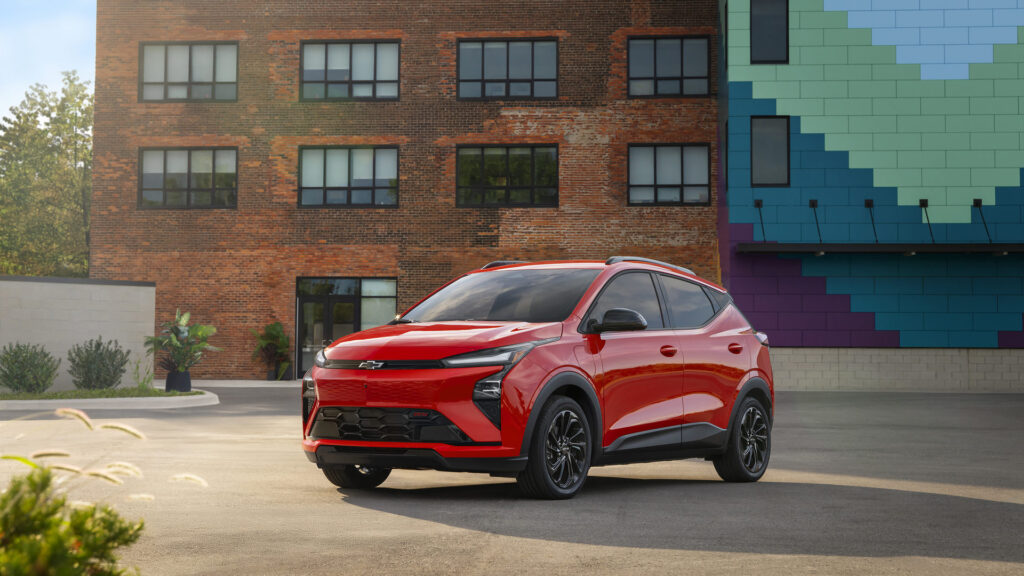
Electric vehicles are no longer a niche purchase in British Columbia, and the Lower Mainland’s charging infrastructure and provincial incentives have pushed more drivers toward making the switch. If you are weighing your options in the compact EV space, the 2027 Chevrolet Bolt and the 2026 Nissan LEAF are two of the most talked-about names right now. Both bring NACS fast charging and modern technology — but when you look at the hardware side by side, the Bolt gives drivers in Pitt Meadows a stronger daily-driving package.
The 2027 Bolt charges faster, gets back on the road quicker, and carries a battery chemistry built to hold its capacity through years of real-world use. The LEAF is a capable, thoughtfully designed EV, but the Bolt’s DC fast charging speed is where the difference becomes tangible for anyone planning longer drives along the Sea-to-Sky corridor or across to the Island.
At a Glance: 2027 Bolt vs. 2026 Nissan LEAF
| Feature | 2027 Chevrolet Bolt | 2026 Nissan LEAF (S+) |
|---|---|---|
| Battery | 65 kWh LFP | 75 kWh lithium-ion |
| Horsepower | 210 hp | 214 hp |
| Torque | 169 lb-ft | 261 lb-ft |
| GM-Estimated Range | Up to 410 km | Up to 488 km (S+) |
| DC Fast Charging Speed | Up to 150 kW | Up to 150 kW |
| DC Fast Charge (10–80%) | 26 minutes | 35 minutes |
| NACS Port | Standard | Standard |
| Drivetrain | FWD | FWD (AWD not available) |
Charging Where It Counts
Both vehicles come with a native NACS port, which means access to the Tesla Supercharger network and a growing number of compatible public stations. That is now table stakes for a modern EV, and both the Bolt and the LEAF tick that box.
Where the Bolt steps ahead is charge speed. With DC fast charging capability up to 150 kW, the Bolt goes from 10% to 80% in 26 minutes. The LEAF hits the same 150 kW ceiling, but its 10–80% fast charge window takes 35 minutes — nine minutes longer. For someone stopping at a Supercharger on the way to Whistler or catching a top-up before loading onto a BC Ferries sailing, those nine minutes are real.
At home, the Bolt supports up to 11.5 kW AC charging, which translates to approximately 64 km of range per hour on a 240V Level 2 station. The LEAF uses a 7.2 kW onboard charger for Level 2. Per the 2026 LEAF specs sheet, 240V Level 2 charge time is listed as TBD. Over a full overnight charge, the Bolt recovers range faster.
- Bolt: 26 minutes (10–80%) at a DC fast charger
- LEAF S+: 35 minutes (10–80%) at a DC fast charger
- Bolt: up to 11.5 kW onboard AC charger; LEAF: 7.2 kW onboard AC charger
Battery Technology and Longevity
The 2027 Bolt uses a 65 kWh Lithium Iron Phosphate (LFP) battery pack in prismatic can cells. LFP chemistry is chemically stable at high states of charge, which is why many EV owners with LFP packs routinely charge to 100% without degrading the pack. The Bolt backs the battery with an 8-year / 160,000 km warranty.
The LEAF S+ uses a 75 kWh lithium-ion pack, which is a larger capacity that contributes to its higher estimated range. The LEAF’s battery thermal management system has been updated for the third generation, including a heat pump and a battery heater that improves cold-weather charging consistency — important for B.C. winters. Both packs have their strengths, but for drivers who regularly use DC fast charging, the Bolt’s LFP chemistry handles repeated fast charge cycles with less concern.
Range in Perspective
The LEAF S+ carries an estimated range advantage — 488 km versus the Bolt’s 410 km. For a driver doing weekly trips between Pitt Meadows and Vancouver, Abbotsford, or Squamish, both ranges are more than enough to handle the round trip without a charge. According to NRCan data, over 80% of Canadian EV drivers charge at home, and the average Canadian drives roughly 50 km per day. At 410 km of GM-estimated range, the Bolt handles those daily needs with ease.
Where the LEAF’s range advantage starts to matter is on longer provincial driving days. But its slower fast charge speed partially offsets that advantage when you do need to stop. The Bolt’s quicker charge sessions mean less time at charging stops on a road day.
Technology and Interior
The 2027 Bolt’s infotainment system integrates Google built-in — including Google Maps, Google Assistant, and route planning that factors in battery range and charging station availability — powered by OnStar Connectivity. Wireless Apple CarPlay and wireless Android Auto are standard.
The LEAF SV+ and PLATINUM+ grades bring dual 14.3-inch screens and Google built-in, while the S and S+ grades use dual 12.3-inch screens. The LEAF’s standard grades also include wireless Apple CarPlay and wireless Android Auto. Both vehicles are well-stocked on the tech front at their respective entry points.
The Bolt includes standard safety features: Enhanced Automatic Emergency Braking, Front Pedestrian and Bicyclist Braking, Intersection Automatic Emergency Braking, Rear Cross Traffic Braking, Lane Keep Assist with Lane Departure Warning, Reverse Automatic Braking, Side Bicyclist Alert, and Rear Park Assist.
The Right EV for Drivers in Pitt Meadows
The LEAF brings a longer estimated range and an updated design that feels like a genuine third-generation EV. The Bolt wins on one of the most practical EV metrics: how quickly you get back on the road when you stop to charge. In British Columbia, where road trip culture is woven into how people use their vehicles, 26 minutes versus 35 minutes is a real difference you will feel every time you pull into a fast charger.
See the 2027 Bolt at Maple Ridge Chevrolet Buick GMC in Pitt Meadows
The 2027 Chevrolet Bolt is available now at Maple Ridge Chevrolet Buick GMC. Book a test drive at our Pitt Meadows location and take the Bolt through the Lower Mainland on your terms.